Research
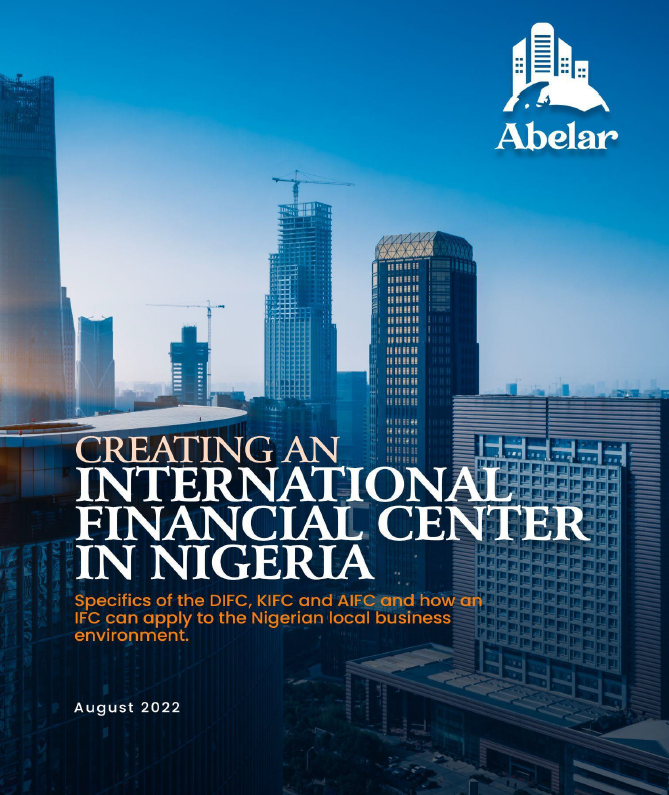
International Financial Centre in Nigeria: An Institutional Blueprint for a New Financial Hub
06 Mar
Background
Investors desire emerging markets but some of these economies lack the sound institutions required to nurture economic growth and attract investment. This makes an International Financial Centre a pivotal establishment. The right economic environment is required to nurture businesses, without that economic in fewer income opportunities for the citizens of these developing nations. This has led to poverty and a low standard of living amongst developing nations.
In the late 20th and early 21st century, entrepreneurial initiatives centered around technology changed the world. The same entrepreneurial spirit can be applied to other socio-economic environments, one of which is the establishment of International Financial Centre’s (IFCs) to overcome the challenges characterized by financial intermediation and trust systems. Creating an International Financial Centre is a broad venture which has a long-term execution span. It is a national agenda that should be driven by both public and private actors.
Purpose
The purpose of this report is to examine the major components and elements that are involved in the creation of an International Financial Centre. It also highlights an Institutional foundation and ideas for policy makers. The report explored case studies from the Dubai International Financial Centre (DIFC), Astana International Financial Centre (AIFC), and the Kigali International Financial Centre (KIFC) to develop a structure that is necessary for establishing an International Financial Centre in Nigeria, which can be replicated elsewhere.
The report started by outlining the different categories of International Financial Centres and how to develop a strategy for an IFC. It expounded on the major component and their structure; the administrative body, the court system and its enforceability, and the finance centre.
Recommendations
The court system must be designed with optimal structure accepted by governments and people. It must be efficient in the settlement of disputes. The financial centre must have a conducive environment to facilitate financial intermediation in the centre. It should also have the characteristics of linking financial services to the rest of the world. The administrative body must have highly experienced individuals who have years of expertise in this field. This is essential for the smooth operation of the centre and attracting its potential markets. Furthermore, it explores the provisions within the laws of the Nigerian Export Processing Zone Authority, some sectorial customizations, and the opportunities a Nigerian international financial centre could create.
Conclusion
International Financial Centres (IFCs) are powerful tools to create economic success. This work is ideal to give a perspective on the major components and various elements of building an IFC for intending builders as well as preliminary ideas to think of before venturing into the project. Abelar stands ready to continue to develop more customised reports and provide technical assistance to this project.
Feel free to download the report
Recent Posts
- International Financial Centre in Nigeria: An Institutional Blueprint for a New Financial Hub
- Administrative Apocalypse and the Prospects of Proprietary Cities
- URBANISATION, GOVERNANCE AND THE ROLES OF ECONOMIC ZONES
- Charter Cities: An Introduction to Entrepreneurial Governance
- The Administrative Apocalypse and the Prospects of Charter Cities
Recent Comments
Recent Posts
- International Financial Centre in Nigeria: An Institutional Blueprint for a New Financial Hub March 6, 2026
- Administrative Apocalypse and the Prospects of Proprietary Cities June 7, 2022
- URBANISATION, GOVERNANCE AND THE ROLES OF ECONOMIC ZONES March 7, 2022
- Charter Cities: An Introduction to Entrepreneurial Governance January 11, 2022
- The Administrative Apocalypse and the Prospects of Charter Cities November 7, 2021
Follow Us
Help

Copyright © 2023 Design by Abelar.org